Hands-On Manual Therapy in St. Catharines
Ask people what they want from physiotherapy and most say some version of "someone who actually puts their hands on me." That expectation is reasonable, and manual therapy is a core part of every treatment here.
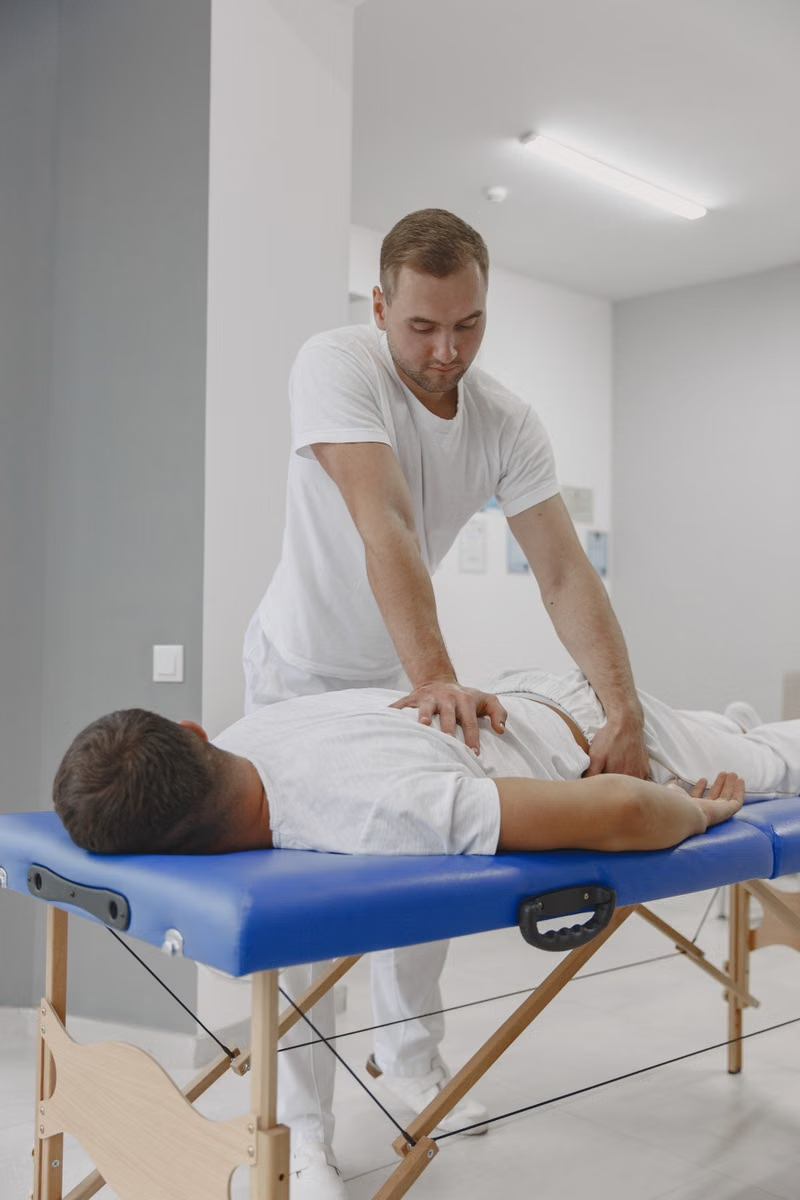
That expectation is reasonable and it is increasingly hard to satisfy. High-volume clinic models have pushed hands-on time out, because one therapist supervising four patients cannot do it. What gets substituted is machines, and machines do not mobilize a stiff joint.
Manual therapy is a core part of every treatment here. It is also not the whole treatment, and any clinic offering only hands-on work is selling you something that wears off.
What Manual Therapy Involves
- Joint mobilization. Graded passive movements applied to a restricted joint to restore its normal glide and range. Different grades serve different purposes: gentle oscillations for pain relief on an irritable joint, sustained end-range pressure for genuine stiffness.
- Joint manipulation. A quick, small-amplitude thrust at the end of a joint's range, sometimes producing an audible pop (which is gas in the joint fluid, not bones moving back into place). Used selectively, with appropriate screening beforehand.
- Soft tissue release. Direct pressure and stripping techniques on muscle and fascia to reduce tone and release trigger points.
- Muscle energy techniques. Using your own controlled muscle contraction against resistance to restore joint position and range.
- Neural mobilization. Specific movements that restore a nerve's ability to glide through surrounding tissue.
- Active Release Technique for adhesions and scar tissue.
- Soft tissue release for muscle tightness and trigger points that have not settled with stretching.
What Manual Therapy Is Good For
It works particularly well for:
Stiff joints that have lost range respond well, whether the stiffness came from injury, a period in a sling or cast, or arthritis. So does acute pain, where hands-on treatment often provides enough relief to make movement possible again, which is the point.
Spinal restriction in the neck, mid-back and lower back is the most common reason people end up on our table. Post-surgical stiffness is the next, particularly knees, shoulders and elbows.
Frozen shoulder deserves its own mention. Sustained end-range mobilization is one of very few things that reliably shifts it, and the technique matters more here than almost anywhere else. Headaches coming from the upper neck respond well too, and they are frequently mistaken for tension headaches or migraine for years before anyone checks the neck. Muscle tightness and trigger points that will not settle with stretching round out the list.
Why Manual Therapy Alone Is Not Enough
Here is the real limitation, and it is worth understanding before you book anywhere.
Manual therapy produces reliable short-term improvements in pain and range of motion. The effects are real and measurable. They are also temporary if nothing else changes, because the reason the joint stiffened or the muscle tightened is still there.
If a stiff mid-back is stiff because you sit for nine hours, mobilizing it on Tuesday buys you until roughly Friday. The mobilization opens a window. What you do in that window determines whether anything lasts.
This is why every manual therapy session here is followed by loading. We mobilize, then we immediately use the new range with exercise so your nervous system learns to hold it. Patients who do the between-session work get lasting change. Patients who come in weekly for years to be "put back into place" are managing a symptom, and someone should have told them that.
What Hands-On Treatment Covers
Hands on physiotherapy in St. Catharines is an umbrella term. Joint mobilization in St. Catharines addresses stiffness at the joint itself, graded from gentle oscillation to sustained end-range pressure. Soft tissue work addresses the muscle and fascia around it. Manual physiotherapy in Niagara at a good clinic uses both, then follows with loading so the change holds. It is the foundation of our broader physiotherapy approach.
FAQs
Book Manual Therapy in St. Catharines
Hands-on treatment to open the window, exercise to keep it open. Book an assessment and we will show you the difference lasting change makes.
Book Your Appointment