Medical Compression Stockings in St. Catharines
Compression stockings only work if they are the right compression class, the right length, and the right size for your leg. Get any one of those wrong and you have bought an uncomfortable sock that does very little.
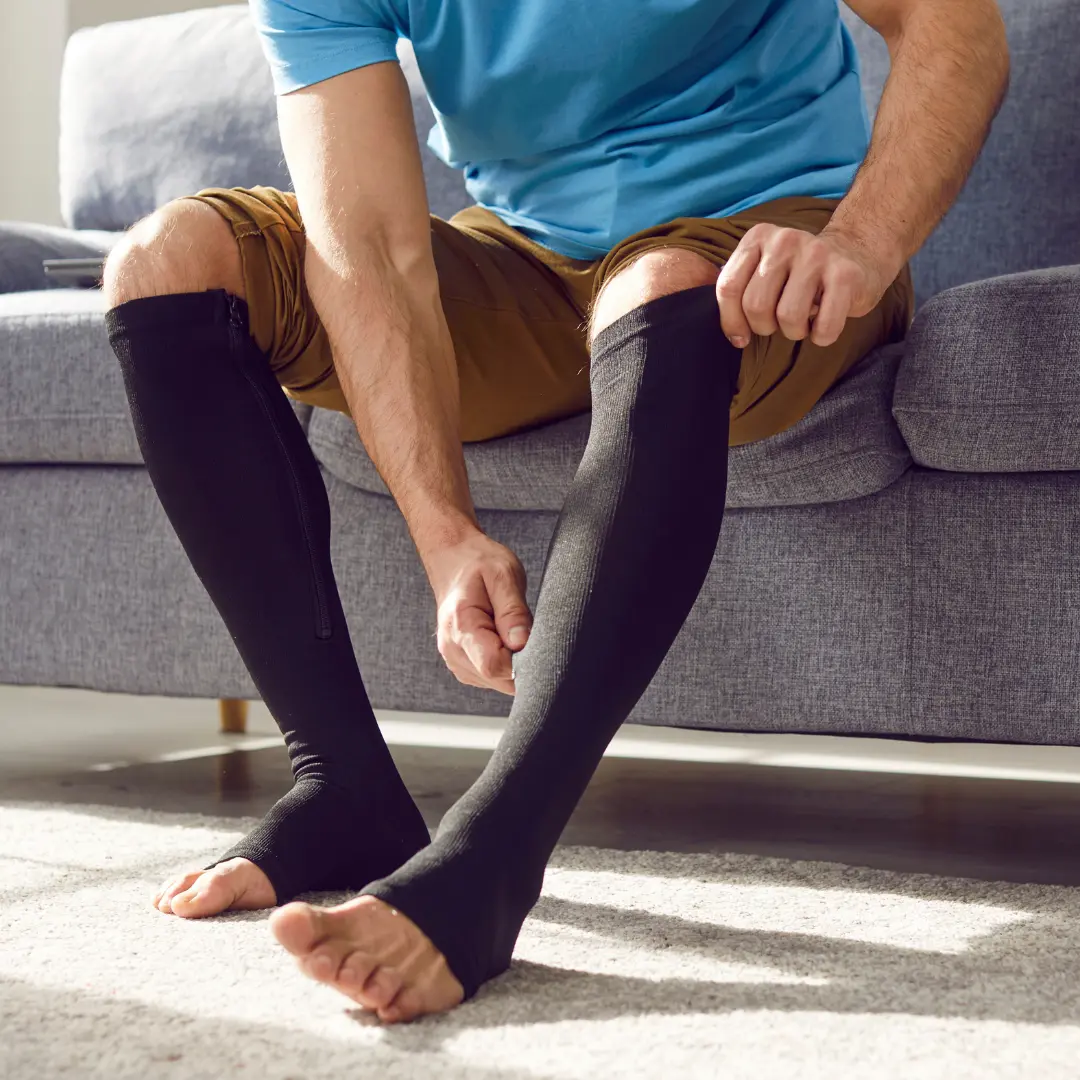
Compression stockings only work if they are the right compression class, the right length, and the right size for your leg. Get any one of those wrong and you have bought an uncomfortable sock that does very little, which is why so many people try compression once, hate it, and give up.
We measure properly. That means a tape measure on your ankle, calf and thigh circumference and your leg length, taken in the morning before swelling accumulates, and a conversation about why you need them in the first place.
Care First Physiotherapy fits and supplies medical grade graduated compression garments at our clinic on Scott Street in St. Catharines.
What Are Graduated Compression Stockings?
Graduated compression means the pressure is highest at the ankle and decreases as it moves up the leg. That gradient is the working part. It helps the veins push blood back toward the heart against gravity, which is the exact thing that fails when someone has venous insufficiency, varicose veins or chronic leg swelling.
This is what separates medical compression from the "compression socks" sold at sporting goods shops, which are often uniform pressure and not classed at all.
Who Benefits From Compression Stockings
| Reason | What is going on |
|---|---|
| Chronic leg swelling (oedema) | Venous insufficiency, heart or kidney conditions |
| Varicose and spider veins | Slows progression and eases the aching |
| Post-thrombotic syndrome, DVT prevention | Especially after surgery or long-haul flights |
| Pregnancy | Swelling and varicose veins are common in the second and third trimesters |
| After vein procedures | Sclerotherapy or vein stripping, where compression is standard protocol |
| Lymphoedema | Including after breast cancer surgery and lymph node removal |
| Standing occupations | Nurses, teachers, servers, hairdressers, retail, factory and line work |
| Athletes and travellers | Recovery and long journeys |
| Diabetes-related circulation problems | Only with physician guidance. Some diabetic patients should not use compression. |
Compression Levels Explained
Compression is measured in millimetres of mercury (mmHg). Choosing the class is a clinical decision, not a preference.
| Class | Pressure | Typically used for | Prescription needed? |
|---|---|---|---|
| Mild | 8-15 mmHg | Tired, achy legs. Prevention. Travel. | No |
| Moderate | 15-20 mmHg | Minor swelling, spider veins, pregnancy, long shifts standing, flights | No |
| Firm (Class I) | 20-30 mmHg | Varicose veins, moderate oedema, post-surgical, DVT prevention, post-sclerotherapy | Usually recommended |
| Extra firm (Class II) | 30-40 mmHg | Severe venous insufficiency, lymphoedema, post-thrombotic syndrome, venous ulcers | Yes, physician directed |
| Class III | 40-50 mmHg | Severe lymphoedema and advanced venous disease | Yes, physician directed |
Most people who come to us end up in the 15-20 or 20-30 range. Going higher without a clinical reason is uncomfortable and offers no additional benefit.
Getting Fitted at Our St. Catharines Clinic
Measuring. We measure ankle circumference at the narrowest point, calf circumference at the widest, thigh circumference if you need thigh-highs, and leg length. Measurements are taken in the morning where possible, because legs swell through the day and an afternoon measurement produces a garment that is too loose the next morning.
Style selection. Knee-high covers most needs. Thigh-high and pantyhose styles are for swelling that extends above the knee. There are also open-toe options, maternity styles, and sizes for wider calves.
Fitting check. We watch you put the first pair on. Getting compression stockings on is genuinely awkward, and there is a technique to it. We also demonstrate donning aids, which are worth every cent if you have arthritic hands or limited hip mobility.
Care instructions. Wash after each wear in cool water, air dry, no fabric softener. Replace every three to six months, because elastic fatigues and a stretched-out stocking is not delivering its rated compression regardless of how it feels.
Cost and Insurance Coverage
Compression stockings are priced per pair, with the measuring and fitting appointment included rather than charged on top. Price varies by compression class and style, so call and tell us what you need.
Most Ontario extended health plans cover compression stockings, typically two to four pairs per year. Nearly all insurers require a physician's prescription stating the compression class and the diagnosis. Some plans also want the garment to be professionally fitted, which is exactly what we provide, and we supply the documentation your insurer will ask for. See our direct billing options for more on coverage.
WSIB and auto insurance will often cover compression garments when they are part of an approved treatment plan.
Where to Buy and How to Choose
Patients asking where to buy medical compression stockings in St. Catharines usually find two options: a pharmacy shelf, or a clinic that measures you. Medical compression socks in St. Catharines bought off a shelf are sized on shoe size, which tells you nothing about calf circumference or ankle-to-knee length. That is why so many pairs end up in a drawer.
We measure, fit and supply compression stockings in Niagara on site, and we re-measure when swelling changes.
FAQs
Book a compression stocking fitting in St. Catharines
Get measured properly, matched to the right compression class, and fitted on site at our Scott Street clinic.
Book Your Appointment